
Introduction
One of the most common questions businesses ask before moving to the cloud is:
"How much does AWS cost in Nepal?"
The answer depends on several factors, including the services you use, your traffic volume, storage requirements, and the size of your applications.
Unlike traditional hosting providers that charge fixed monthly fees, Amazon Web Services (AWS) follows a pay-as-you-go model. This means you only pay for the resources you consume.
In this guide, we'll explain AWS pricing in simple terms, provide real-world examples, and help Nepalese businesses estimate their cloud costs more accurately.
What Is AWS?
Amazon Web Services (AWS) is the world's leading cloud computing platform, offering more than 200 services for:
Website hosting
Application deployment
Data storage
Database management
Artificial intelligence and machine learning
Security and monitoring
DevOps and automation
Companies ranging from startups to large enterprises use AWS because of its scalability, reliability, and global infrastructure.
Does AWS Have Special Pricing for Nepal?
No.
AWS pricing is generally the same worldwide.
Businesses in Nepal pay in USD, and charges are based on the AWS services and resources they consume.
However, the actual monthly cost depends on:
Number of users
Website traffic
Storage requirements
Application architecture
Security and compliance requirements
Backup and disaster recovery needs
Typical AWS Costs for Businesses in Nepal
Small Business Website
A small company website or portfolio site may require:
Amazon EC2
Amazon S3
Route 53
Basic monitoring
Estimated monthly cost:
$10–$50 per month
Suitable for:
Business websites
Corporate portfolios
Landing pages
Small web applications
Growing Startup
A startup with active users may require:
EC2 instances
Managed database (RDS)
Load balancer
Storage
Backup services
Estimated monthly cost:
$100–$500 per month
Suitable for:
SaaS applications
E-commerce platforms
Mobile applications
Internal business systems
Enterprise Workloads
Organizations running production systems may require:
Multiple environments
High availability architecture
Security controls
Monitoring
Backup and disaster recovery
Estimated monthly cost:
$500–$5,000+ per month
Suitable for:
Large enterprises
Financial institutions
Healthcare platforms
High-traffic applications
AWS Free Tier
AWS provides a Free Tier that allows new users to experiment with many services at no cost for a limited period.
The Free Tier includes selected usage limits for:
EC2 virtual servers
S3 storage
Lambda functions
Databases
Monitoring services
This is ideal for students, developers, and businesses evaluating AWS before committing to production workloads.
Hidden Costs Businesses Should Understand
Many organizations underestimate cloud costs because they focus only on servers.
Additional costs may include:
Data Transfer
Moving data between services or out of AWS can generate charges.
Storage Growth
As files, images, logs, and backups increase, storage expenses can grow over time.
Database Usage
Managed databases provide convenience but often cost more than basic virtual servers.
Monitoring and Logging
Advanced monitoring tools improve visibility but may add additional costs.
Backup and Disaster Recovery
Reliable backup strategies are essential and should be included in cloud budgeting.
How to Reduce AWS Costs
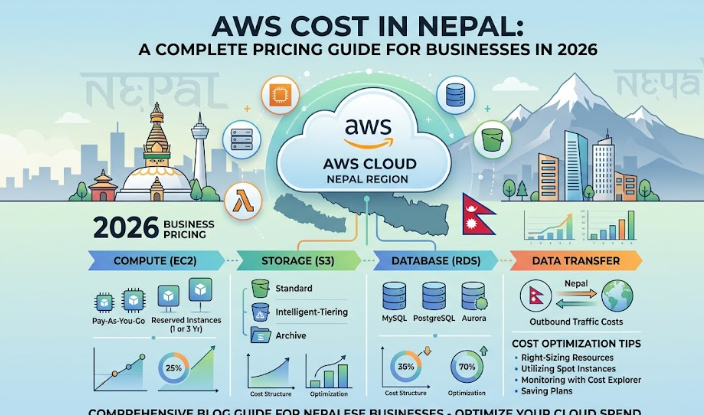
Businesses can optimize spending by:
Using right-sized resources
Enabling auto-scaling
Removing unused services
Monitoring utilization regularly
Implementing cost governance policies
Leveraging Reserved Instances where appropriate
Many companies can reduce cloud expenses by 20–40% through proper optimization.
Is AWS Worth the Cost?
For most businesses, AWS is often more cost-effective than maintaining physical servers.
Benefits include:
No hardware investment
Faster deployment
Improved reliability
Enhanced security
Global scalability
Access to advanced AI and cloud services
Rather than paying for infrastructure that sits idle, businesses only pay for what they actually use.
How Digo Solution Helps
At Digo Solution, we help businesses plan, migrate, optimize, and manage AWS environments.
Our services include:
AWS cloud consulting
Cloud migration
Infrastructure design
DevOps implementation
Cost optimization
Security best practices
Managed cloud services
Whether you're exploring AWS for the first time or looking to reduce existing cloud costs, our team can help you build a secure and cost-effective cloud strategy.
Frequently Asked Questions
Can I use AWS in Nepal?
Yes. AWS services are fully available to businesses and organizations in Nepal.
Does AWS charge in Nepali Rupees?
AWS billing is typically processed in USD.
Is AWS expensive for small businesses?
Not necessarily. Small websites and applications can often run on AWS for less than $50 per month.
How can I estimate AWS costs before deployment?
AWS provides pricing calculators, but a cloud assessment from experienced AWS consultants can often provide a more accurate estimate.
Conclusion
AWS pricing in Nepal depends entirely on how you use cloud resources. Small businesses may spend only a few dollars per month, while enterprise workloads can scale significantly based on demand.
The key to controlling costs is proper architecture, monitoring, and optimization. With the right strategy, AWS can provide exceptional performance, security, and scalability while remaining cost-effective for businesses of all sizes.